This is usually the biggest decision people face once they have decided to buy a home blood pressure monitor. Both wrist and arm monitors measure the same thing, and both can give you reliable readings when used correctly. The real question is not which one is objectively “better,” it is which one fits your body, your budget, and your daily routine. Here is how to make that decision with confidence.
The Short Version
If you want the closest thing to a clinical standard and do not mind a slightly bulkier device, choose an arm monitor. If you want something compact, fast, and more affordable that you will actually use every day without friction, a wrist monitor is often the better real-world choice. Neither answer is wrong, they simply serve different priorities.
Cost and Convenience vs Clinical Accuracy
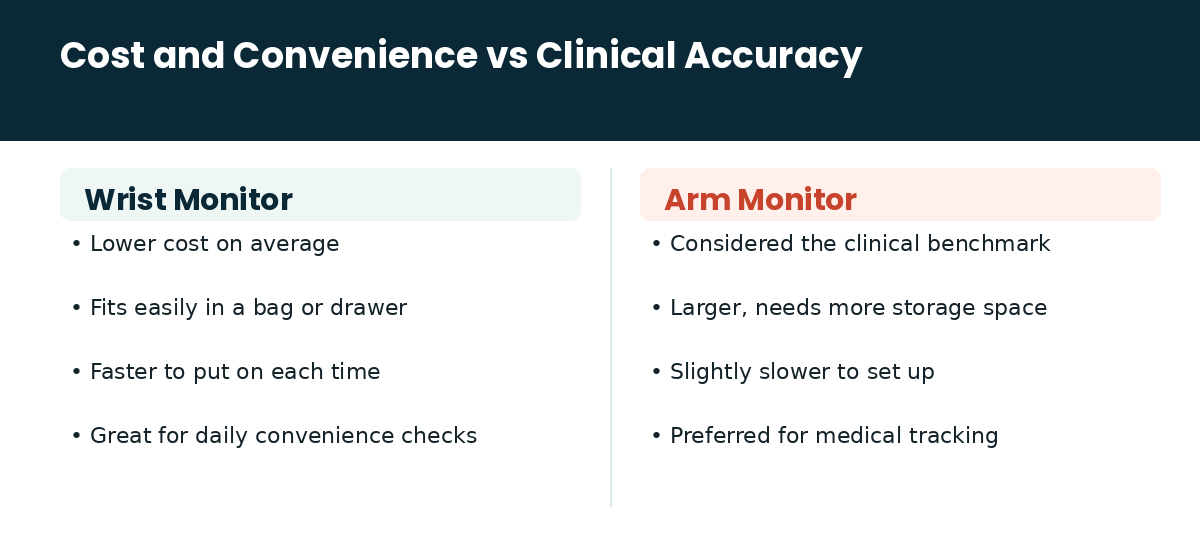
Arm monitors are generally considered the reference standard in clinical guidelines, largely because they are more forgiving of small positioning mistakes (AHA guidance on home blood pressure monitoring). Wrist monitors, on the other hand, tend to be smaller, quicker to use, and often cheaper, but they do require more attention to positioning to get an accurate reading, specifically keeping your wrist level with your heart during measurement.
Neither of these facts should be treated as a dealbreaker. Millions of people successfully use wrist monitors every day. What matters is understanding the trade-off so you can use whichever device you choose correctly.
Choose a Wrist Monitor If You…
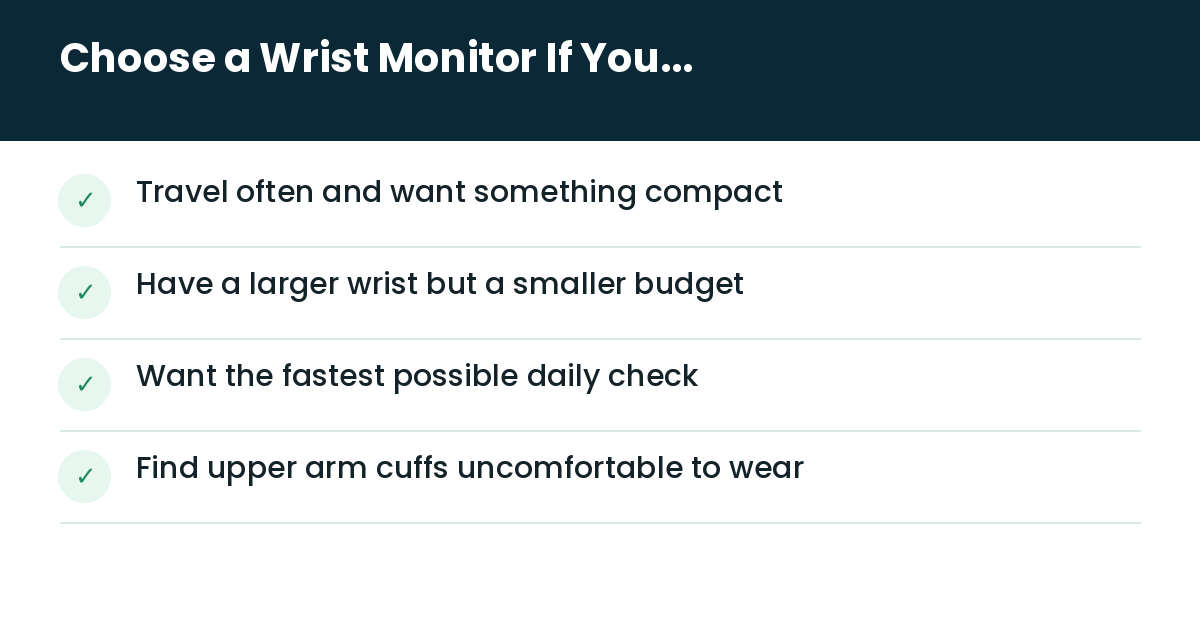
A wrist monitor tends to be the right fit for people who travel frequently and want something that fits easily in a bag, people with a larger wrist who still want an affordable option, anyone who wants the fastest possible daily check without much setup, and people who simply find upper arm cuffs uncomfortable or difficult to wrap correctly on their own.
Choose an Arm Monitor If You…
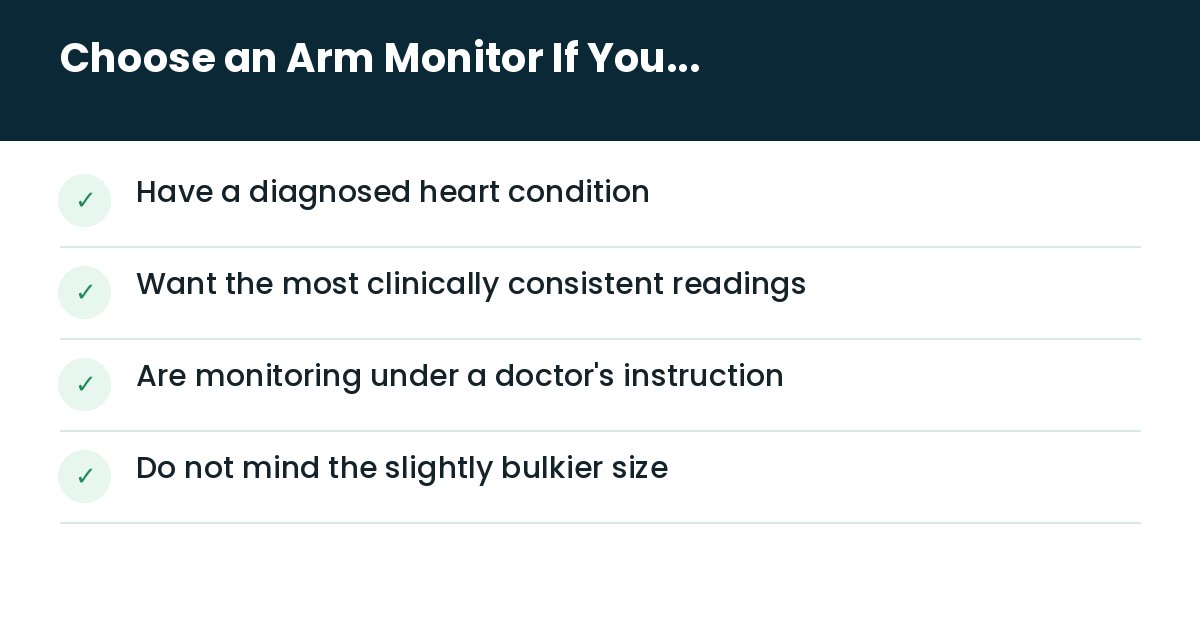
An arm monitor makes more sense if you have a diagnosed heart condition and need the most clinically consistent readings possible, if you are monitoring under specific instructions from a doctor, or if you simply do not mind the slightly bulkier size in exchange for a device that is somewhat more forgiving of positioning errors.
What the Evidence Actually Says
It is worth being honest that clinical opinion is not unanimous here. Some research has raised concerns about wrist monitor reliability in unsupervised, everyday use, which is part of why several major health bodies still recommend an arm monitor as the default option when one is available and comfortable (Cleveland Clinic on wrist blood pressure monitors). At the same time, Mayo Clinic notes that a wrist monitor can be a perfectly reasonable choice for people who cannot use an arm cuff comfortably, and remains accurate when used exactly as directed.
In practice, the device that gets used correctly and consistently will always outperform the “better” device that sits unused in a drawer because it felt inconvenient. This is worth remembering when making your decision.
A Simple Way to Decide
Ask yourself one honest question: will I actually use this device regularly? If a bulkier arm monitor feels like a chore to set up every time, you are more likely to skip checking your blood pressure altogether, which defeats the entire purpose. A wrist monitor that you actually pick up and use every morning will give you far more useful data over time than an arm monitor gathering dust.
Where to Buy in Nigeria
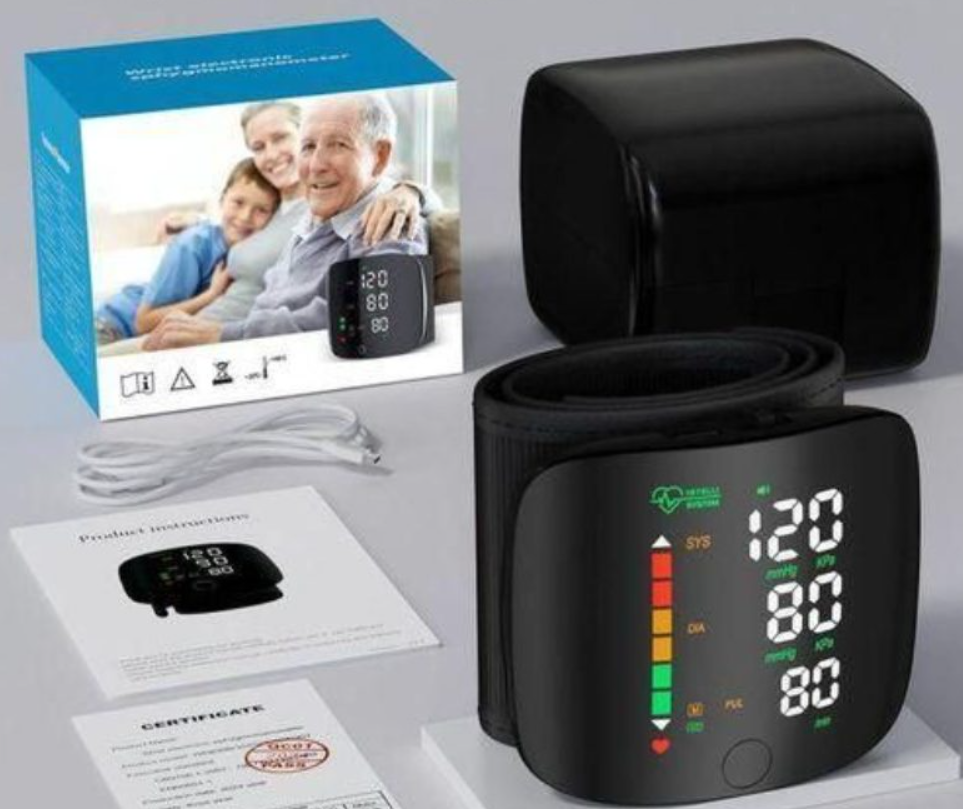
Whichever direction you lean, ClinicAid has you covered. Our Digital Wrist Blood Pressure Monitor is our most popular option for home use, combining accuracy with everyday convenience. For frequent travelers, the Portable Digital Wrist Blood Pressure Monitor is built specifically to move with you, and our standard Wrist BP Monitor is a dependable, simple option for daily home tracking.
Final Thoughts
There is no universally correct answer between wrist and arm monitors, only the answer that fits how you will actually live with the device day to day. If you want maximum clinical consistency and do not mind the bulk, go with an arm monitor. If you want something you will genuinely use every single day without a second thought, a wrist monitor, used correctly, is a smart and reliable choice.
For more comparisons and buying advice, browse the ClinicAid blog.
Thinking Beyond the Purchase
Whichever monitor you choose, remember that the device itself is only the starting point. What actually improves your health outcomes is the habit built around it, checking regularly, understanding your numbers, and following up with a doctor when patterns suggest you should. A slightly less “ideal” device that you use every day will always deliver more real-world value than a technically superior one that ends up forgotten in a drawer after the first week. Buy the one that fits into your life, not just the one that looks best on paper.
A Word on Budget
Price should not be the only factor, but it is a legitimate one, especially for households monitoring blood pressure for more than one family member. Wrist monitors generally offer a lower entry cost without sacrificing the core accuracy you need for daily home tracking, which makes them a sensible starting point for many Nigerian households working within a defined budget.
Frequently Asked Questions
Is it ever worth owning both a wrist and an arm monitor? For some households, yes. A common approach is using an arm monitor for periodic, careful checks and a wrist monitor for quick daily tracking. This is not necessary for most people, but it can be a reasonable choice if budget allows and you want the benefits of both.
Which type do doctors in Nigeria typically recommend? Most doctors default to recommending an arm monitor when discussing home monitoring, largely following international clinical guidelines. That said, many are comfortable with a wrist monitor as well, provided it is used correctly, particularly for patients who find an arm cuff impractical.
Does a wrist monitor wear out faster than an arm monitor? Not typically. Both types use similar internal components, and with normal care, neither should wear out significantly faster than the other. The cuff material on either type may show wear over years of daily use, but this is unrelated to whether it is worn on the wrist or arm.
Can children or teenagers use a wrist blood pressure monitor? Wrist monitors are generally designed and validated for adult use. If you need to monitor a child or teenager’s blood pressure, it is best to consult a pediatrician about the most appropriate device and cuff size for their smaller wrist or arm.
If I am unsure which to choose, which one should I start with? If you genuinely cannot decide, a wrist monitor is a reasonable starting point for most healthy adults without diagnosed heart conditions, given its lower cost and ease of daily use. You can always add an arm monitor later if your needs change or a doctor recommends one specifically.
If I buy a wrist monitor now, can I switch to an arm monitor later without issues? Yes, there is no downside to switching later if your needs change, for example if a doctor recommends closer clinical-style tracking after a diagnosis. Many people start with a wrist monitor for general awareness and add or switch to an arm monitor only if a specific medical reason arises.

Digi Clinicaid Nigeria Ltd is an online medical marketplace in Nigeria.