With so many wrist blood pressure monitors on the market, all claiming to be accurate, how do you actually tell which ones are trustworthy and which are just making noise? This guide walks through the real signs of a genuinely accurate device, the warning signs of one that is not, and how to verify accuracy for yourself once you own one.
Why “Most Accurate” Is Not About a Single Brand
It is worth starting with an honest point: there is no single universally “most accurate” wrist monitor that outperforms every other validated device on the market. What actually determines accuracy is a combination of the device’s build quality, whether it has undergone genuine validation testing, and, just as importantly, how correctly it is used every time you take a reading. A well-validated, mid-range monitor used correctly will consistently outperform an expensive device used carelessly.
Signs of a Genuinely Accurate Monitor
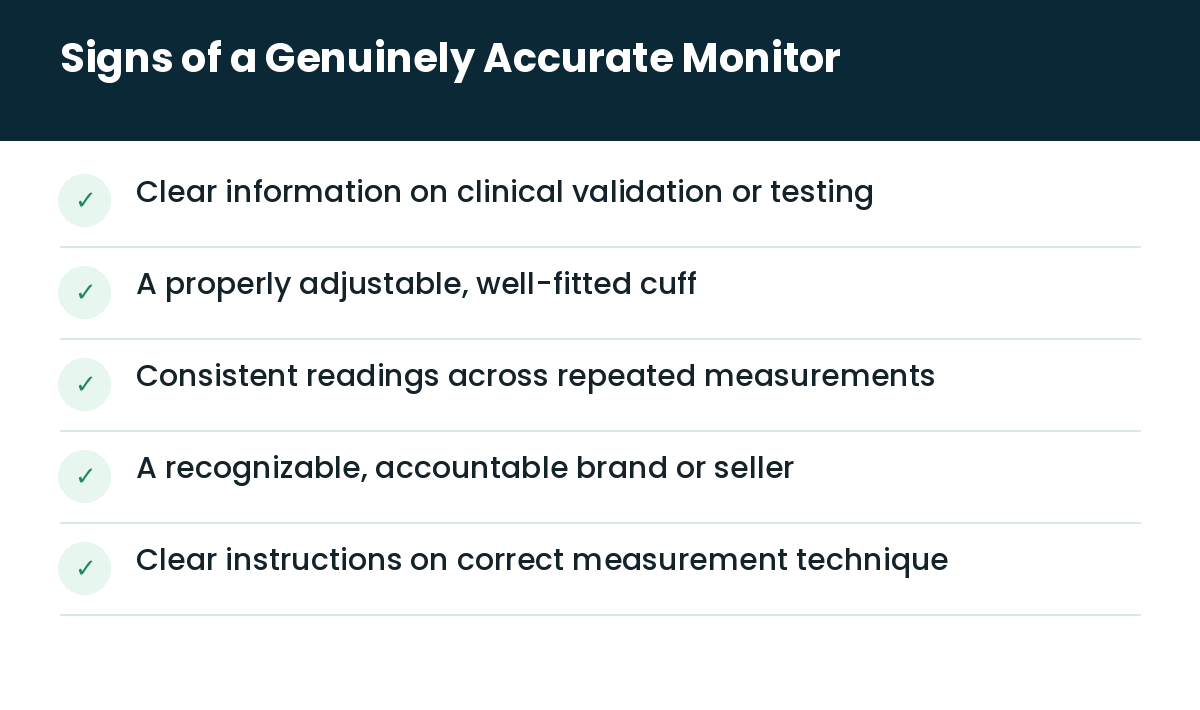
Look for clear information about clinical validation or testing behind the device, rather than vague claims with no substance. A properly adjustable, well-fitted cuff is essential, since fit directly affects accuracy. Consistent readings across repeated measurements, taken correctly, are a strong practical sign that a device is performing reliably. A recognizable, accountable brand or seller gives you somewhere to turn if you have concerns. And clear instructions on correct measurement technique included with the device suggest the manufacturer understands, and cares about, how much technique affects results.
Red Flags of an Unreliable Device
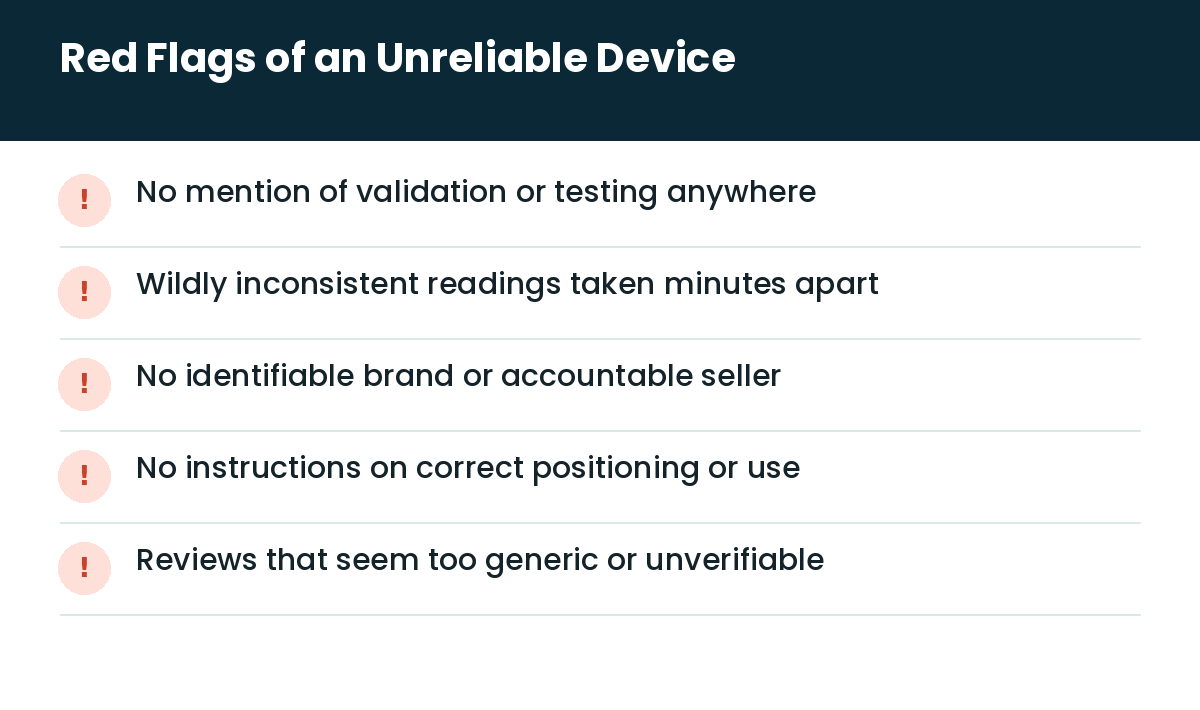
Be wary of any device with no mention of validation or testing anywhere in its listing or packaging. Wildly inconsistent readings taken just minutes apart, with no clear explanation like a change in position, are a genuine warning sign. No identifiable brand or accountable seller behind the product makes it difficult to trust or seek support from. A complete absence of instructions on correct positioning or use suggests the manufacturer is not prioritizing accurate results. And reviews that feel generic, repetitive, or impossible to verify are a common sign of manipulated feedback rather than genuine customer experience.
How to Verify Accuracy Yourself
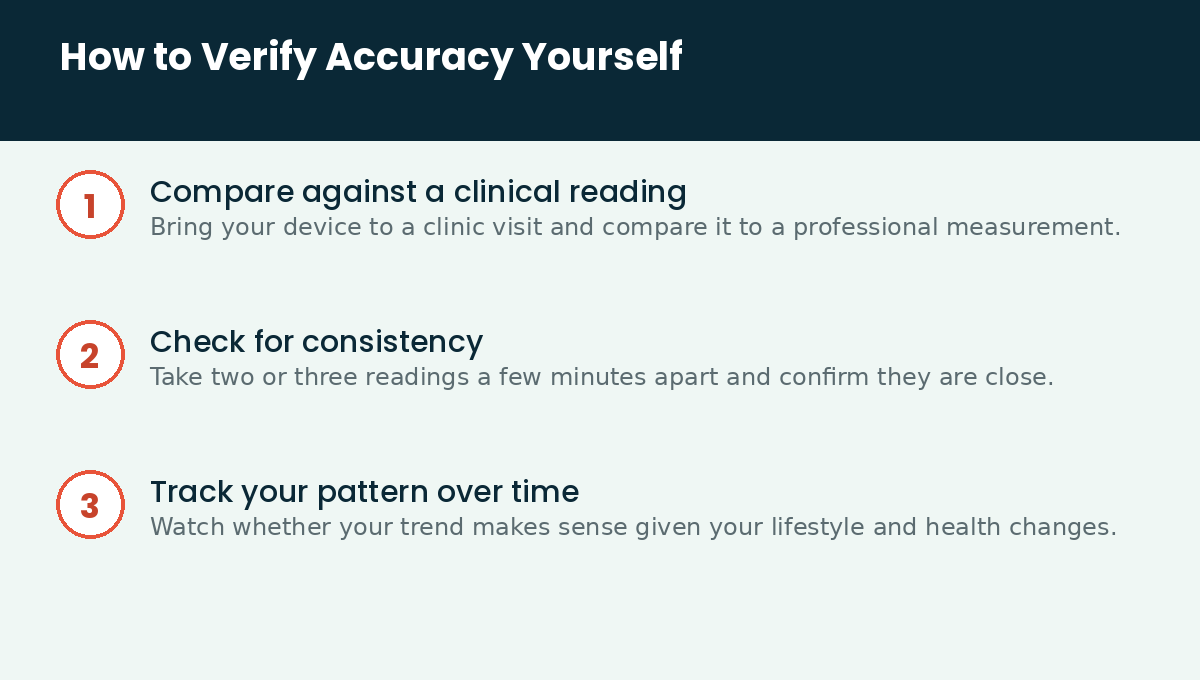
Once you own a device, there are simple ways to build genuine confidence in it. Bring it with you to a clinic visit and compare your reading against a professional measurement taken around the same time. Check for consistency by taking two or three readings a few minutes apart and confirming they land close together rather than varying wildly. And track your pattern over time, watching whether the trend makes sense given your actual lifestyle, diet, and any health changes you are aware of, rather than reacting to any single number in isolation.
Understanding Clinical Validation
Clinical validation generally means a device has been tested against established medical standards to confirm its readings align closely with a trusted reference method under controlled conditions. This is genuinely the single most meaningful signal of quality when comparing devices, more meaningful than price, brand recognition, or the number of features listed. Unfortunately, not every seller makes validation information easy to find, which is exactly why it is worth specifically looking for before you buy, rather than assuming it based on price or appearance alone.
Accuracy Is Also About You, Not Just the Device
It bears repeating throughout this topic: even the most rigorously validated monitor will give you misleading numbers if used incorrectly. Sitting quietly beforehand, positioning your wrist at heart level, staying still during measurement, and taking two readings instead of relying on one are not optional extras, they are part of what “accurate” actually means in practice. A trustworthy device paired with careless technique will still mislead you, while a solid, validated device paired with correct technique will consistently serve you well.
Choosing a Trustworthy Option
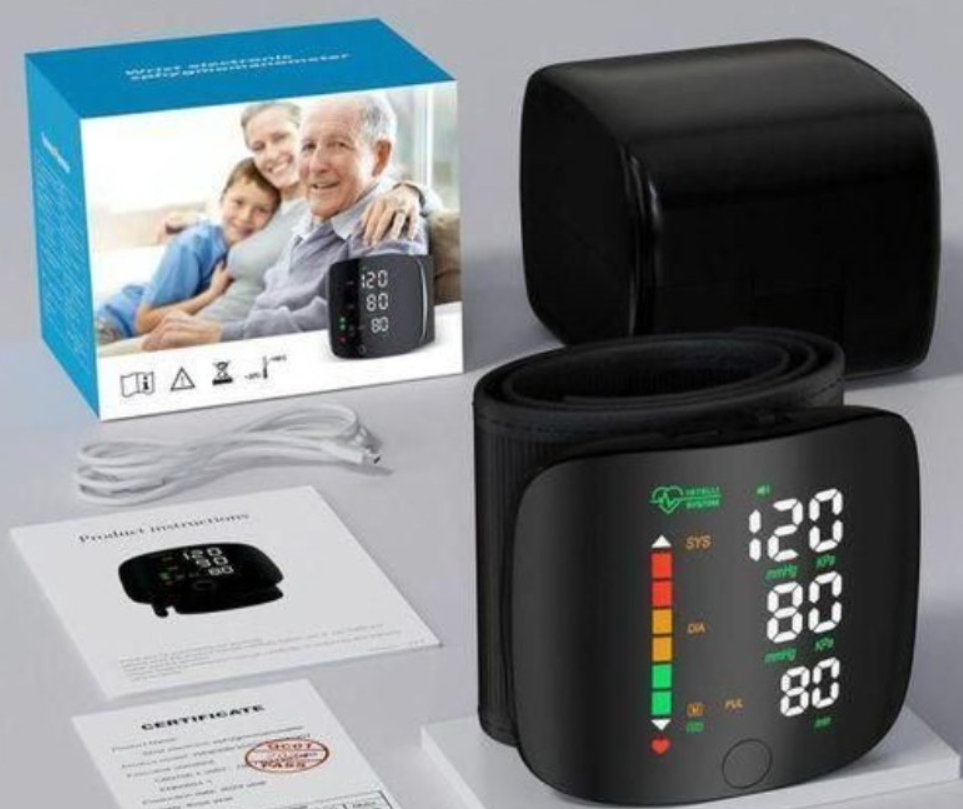
Our Digital Wrist Blood Pressure Monitor is built around exactly the standards covered in this guide, genuine accuracy, a properly adjustable cuff, and clear guidance on correct use, backed by real support from our team if you ever have questions. The same reliability carries through to our Portable Digital Wrist Blood Pressure Monitor for those who need it on the move, and our standard Wrist BP Monitor for everyday dependable tracking.
The Role of User Reviews, Used Carefully
Genuine user reviews can be a helpful signal, but they need to be read critically rather than taken entirely at face value. Look for reviews that mention specific, believable details, how the display looks, how the cuff fits, whether delivery was smooth, rather than generic praise that could apply to any product. A healthy mix of positive reviews alongside a few honest, specific criticisms is often more trustworthy than a suspiciously perfect five-star record with no detail behind it at all.
Why This Matters More Than It Might Seem
Choosing an inaccurate device is not a purely financial risk, it is a health risk. A monitor that consistently reads falsely low could give you dangerous reassurance while your actual blood pressure quietly climbs. A monitor that consistently reads falsely high could cause unnecessary stress, or worse, lead to inappropriate medication adjustments based on numbers that were never accurate to begin with. This is exactly why the extra few minutes spent verifying a device’s validation and testing credentials before you buy are genuinely worth it, far more than comparing feature lists or shaving a small amount off the purchase price.
Frequently Asked Questions
How can I check if a specific device has been clinically validated? Look for validation information in the product listing, packaging, or manufacturer’s documentation. If it is not clearly stated, it is reasonable to ask the seller directly before purchasing, or to choose a different, more transparent option.
Can two validated devices still give slightly different readings? Yes, small variation between two accurate devices is normal and expected, since no two measurements, even from the same device, will be perfectly identical every time. What matters is that each device gives you consistent, trend-worthy results over time.
Does an expensive price always mean better accuracy? No, price often reflects added features like memory capacity or rechargeable batteries rather than a meaningful difference in core accuracy. A validated, appropriately priced device is generally just as accurate as a much pricier one with the same underlying technology.
How often should I double check my device’s accuracy? Checking against a professional reading once every few months, or whenever you have a routine clinic visit, is a reasonable habit to build ongoing confidence in your device’s performance.
What should I do if I suspect my device has become inaccurate over time? Compare it against a clinical reading as soon as possible, and reach out to the seller or manufacturer for guidance. If the discrepancy is significant and consistent, it may be time to replace the device.
Is it possible for a device to be accurate for one person but not another? Yes, cuff fit plays a real role here. A device that is accurate on a typical adult wrist may perform less reliably on someone with an unusually small or large wrist if the cuff cannot adjust to fit properly, which is part of why cuff adjustability matters so much when evaluating accuracy.
Does firmware or software ever affect a digital monitor’s accuracy? The internal calibration set during manufacturing is what primarily determines accuracy, and this generally does not change or degrade through normal use over the device’s lifespan under typical home conditions.
For more on choosing a monitor you can genuinely trust, visit the ClinicAid blog.

Digi Clinicaid Nigeria Ltd is an online medical marketplace in Nigeria.