This is the single most common question we get from people considering a wrist blood pressure monitor, and it is a fair one to ask before spending money on a health device. The short answer is that wrist monitors can be accurate, but their accuracy depends heavily on how they are used, more so than upper arm monitors do. Here is what the evidence actually shows, and how to make sure you are getting reliable numbers.
The Honest Answer
According to Mayo Clinic, wrist blood pressure monitors can produce accurate readings when they are used exactly as directed and checked periodically against a reading taken in a medical office (Mayo Clinic FAQ on wrist monitor accuracy). The technology inside a wrist monitor is not fundamentally different from what is inside an upper arm monitor, it measures pressure through an artery using an inflatable cuff and a digital sensor.
The difference is sensitivity to technique. The radial artery in your wrist is narrower and closer to the surface than the artery in your upper arm, which makes wrist readings more easily thrown off by small errors in positioning. That does not mean wrist monitors are unreliable, it means they reward correct use and punish careless use more than arm monitors do.
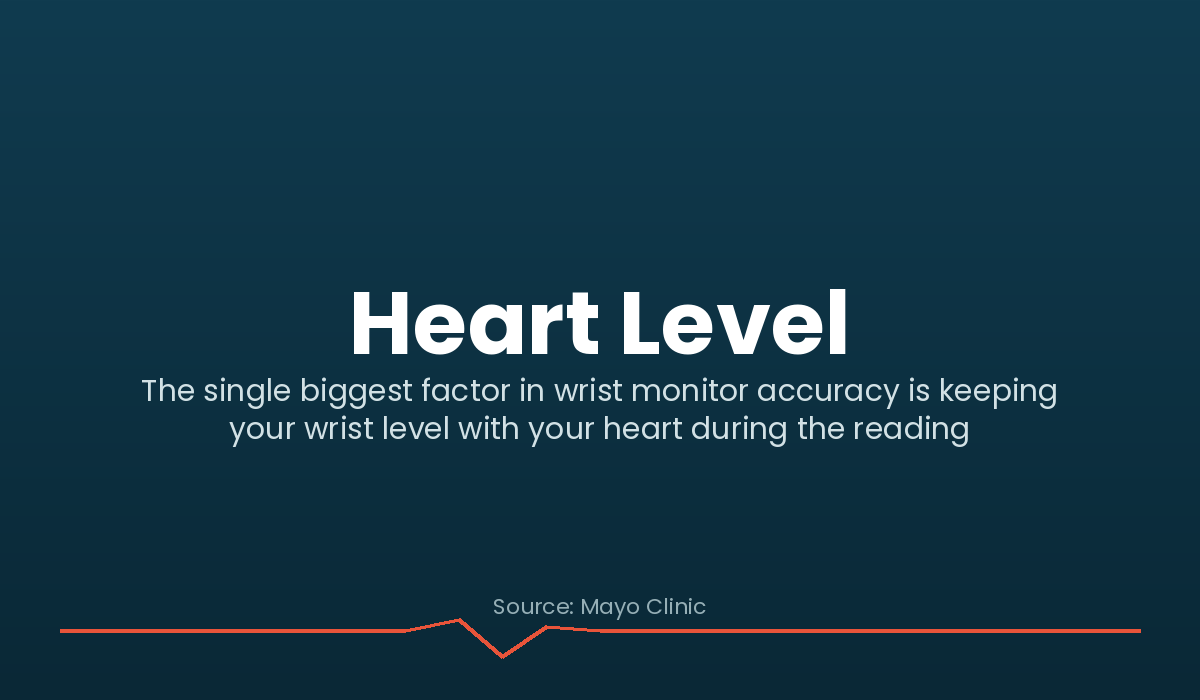
The One Factor That Matters Most: Heart Level
If there is one thing to remember from this entire article, it is this: your wrist must be positioned at the same level as your heart when you take a reading. If your wrist is too high or too low, the reading will be thrown off, sometimes significantly, giving you a false high or false low result.
This single detail explains most of the complaints people have about wrist monitor accuracy. It is rarely the device itself that is the problem, it is how it was held during the reading.
What the Research Says
Clinical literature on wrist monitors is mixed, and it is worth being transparent about that rather than only telling you what is convenient. Some studies have raised concerns about the reliability of unsupervised, at-home wrist self-measurement in certain populations, which is part of why the American Heart Association still recommends an upper arm monitor as the general default whenever one is available and comfortable to use (AHA on home blood pressure monitoring).
At the same time, Mayo Clinic notes that wrist monitors remain a reasonable option for people who cannot use an arm cuff comfortably, including people with very large arms, or people who have had lymph nodes removed from the armpit, where an arm cuff is not advisable at all. For these groups, and for anyone using a wrist monitor correctly and consistently, it remains a genuinely useful tool.
Tips for a More Accurate Reading
The good news is that most of what affects wrist monitor accuracy is fully within your control.
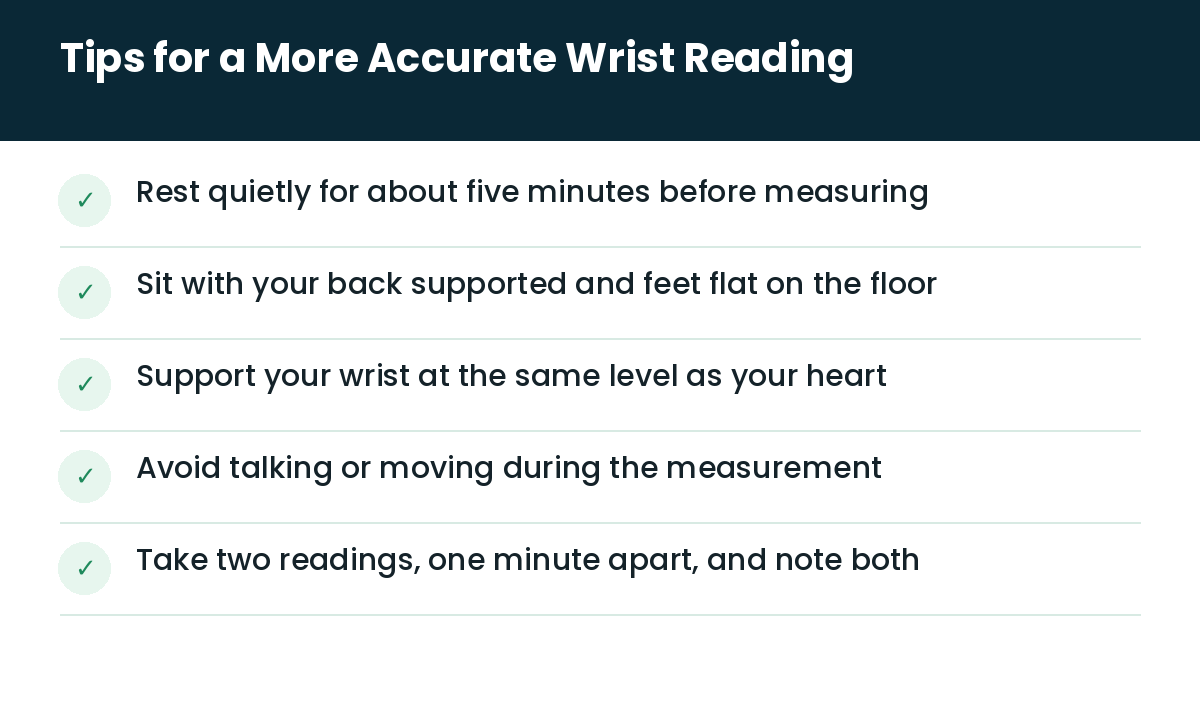
Sit quietly for five minutes first. Rushing straight from a task into a reading is one of the most common causes of an inflated number.
Support your wrist at heart level. Resting your wrist against your chest, with your elbow supported, is usually the easiest way to get this right.
Stay still and stay quiet. Talking, shifting in your seat, or crossing your legs during the reading can all skew the result.
Avoid caffeine, food, and exercise beforehand. Give it at least 30 minutes before you measure.
Take two readings, one minute apart. If they are close, use the average. If they are very different, take a third and average all three.
What Helps and What Hurts Your Reading
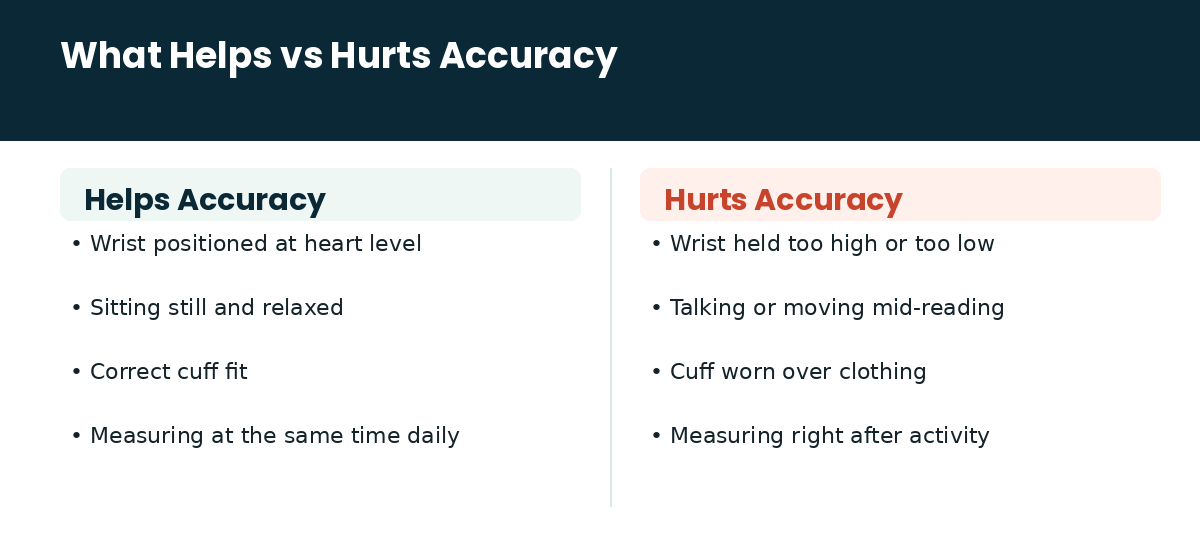
If you keep the left-hand column as your habit and avoid the right-hand column, you will get readings that are close to what a clinical device would show you in the same moment.
Validating Your Device
If accuracy is a genuine concern for you, there is a simple way to settle it. Bring your wrist monitor with you to your next clinic visit and ask a nurse or doctor to compare your home reading against theirs, taken at roughly the same time. Cleveland Clinic recommends exactly this approach as a way to confirm your specific device is working well for your specific wrist (Cleveland Clinic on wrist blood pressure monitors).
Choosing a Monitor Built for Accuracy
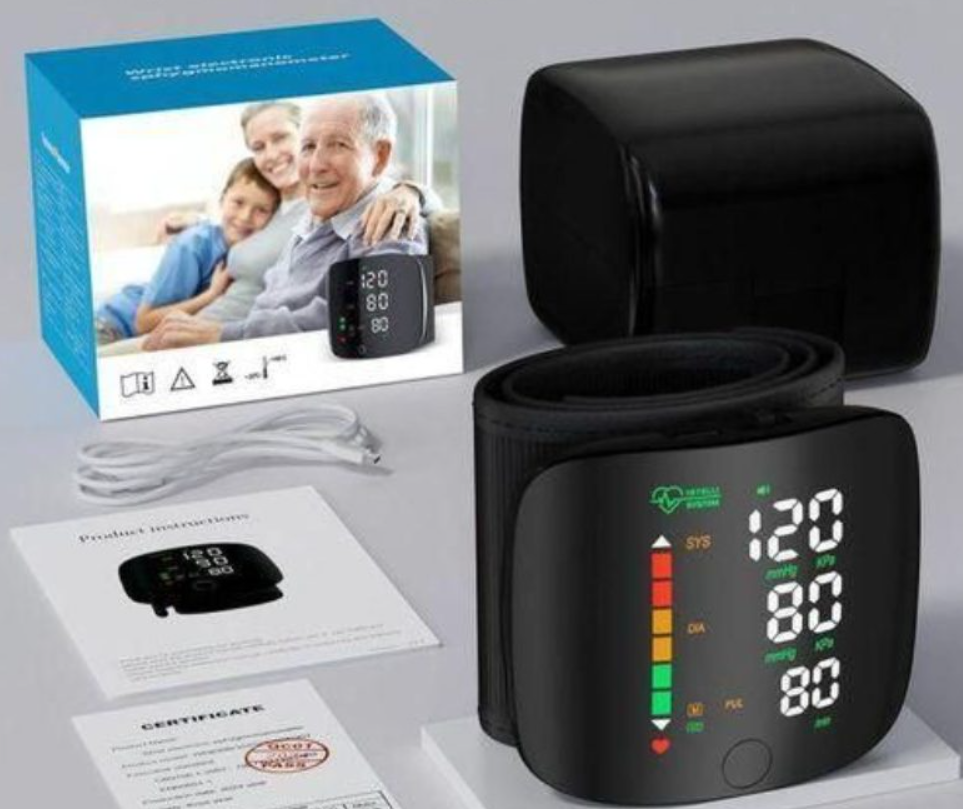
Not all wrist monitors are made equally, and buying a cheap, unvalidated device is often where accuracy problems actually start. Our Digital Wrist Blood Pressure Monitor uses automatic one-touch measurement with a snug, adjustable cuff designed to minimize the positioning errors that cause most inaccurate readings. If portability is important to you as well, take a look at our Portable Digital Wrist Blood Pressure Monitor, or browse the standard Wrist BP Monitor for a simpler everyday option.
Bottom Line
Wrist blood pressure monitors are not inherently less trustworthy than arm monitors, they are simply less forgiving of mistakes. Used correctly, at heart level, while sitting still and relaxed, a good wrist monitor can give you genuinely reliable numbers to track over time. Used carelessly, any monitor, wrist or arm, can mislead you.
For more on getting the most out of home monitoring, read our full guide on the ClinicAid blog.
A Word on Trusting Your Numbers Over Time
Accuracy is not just about a single perfect reading, it is about building a trustworthy pattern over days and weeks. Even if one reading is slightly off due to a missed step in technique, a consistent daily habit will usually reveal the true trend in your blood pressure, since genuine changes tend to show up repeatedly, while one-off technique errors do not. This is why doctors are often more interested in a week of your home readings than a single number brought in on the day of your appointment.
Frequently Asked Questions
Why does my wrist monitor give a different reading than my arm monitor? Small differences between the two are normal, since they measure at different points in your circulatory system. If the difference is large or consistent, it is usually a sign of positioning error on the wrist reading rather than a fault with either device. Try repositioning your wrist carefully at heart level and measuring again.
Are more expensive wrist monitors always more accurate? Not necessarily. Price alone does not guarantee accuracy. What matters more is whether the device has been clinically validated and whether the cuff fits your wrist properly. A moderately priced, validated monitor used correctly will outperform an expensive device used carelessly.
Can stress or anxiety affect the accuracy of my reading? Stress does not make the device itself less accurate, but it does genuinely raise your blood pressure in the moment, which is why the reading may be higher than your baseline. This is sometimes called white coat effect, and it is a real physiological response, not a device malfunction. Sitting quietly for a few minutes before measuring helps reduce this effect.
Should I trust a single low reading that seems too good to be true? Not on its own. Just as a single high reading can be an outlier, so can an unusually low one. Take a second reading a minute later, and if you are unsure, a third. Consistency across multiple readings is far more meaningful than any single number.
How often should I check my device against a clinical reading? There is no strict rule, but checking your device against a professional reading once every few months, or whenever you have a routine clinic visit, is a reasonable way to confirm it is still performing accurately over time.

Digi Clinicaid Nigeria Ltd is an online medical marketplace in Nigeria.