If you have already read a general comparison of wrist and arm monitors and still are not sure which one is right for you, this article goes one level deeper. Instead of a broad overview, here is a straightforward breakdown of the specific pros and cons of each type, and clear scenarios for who tends to be best served by each one.
Wrist Monitor: Pros and Cons
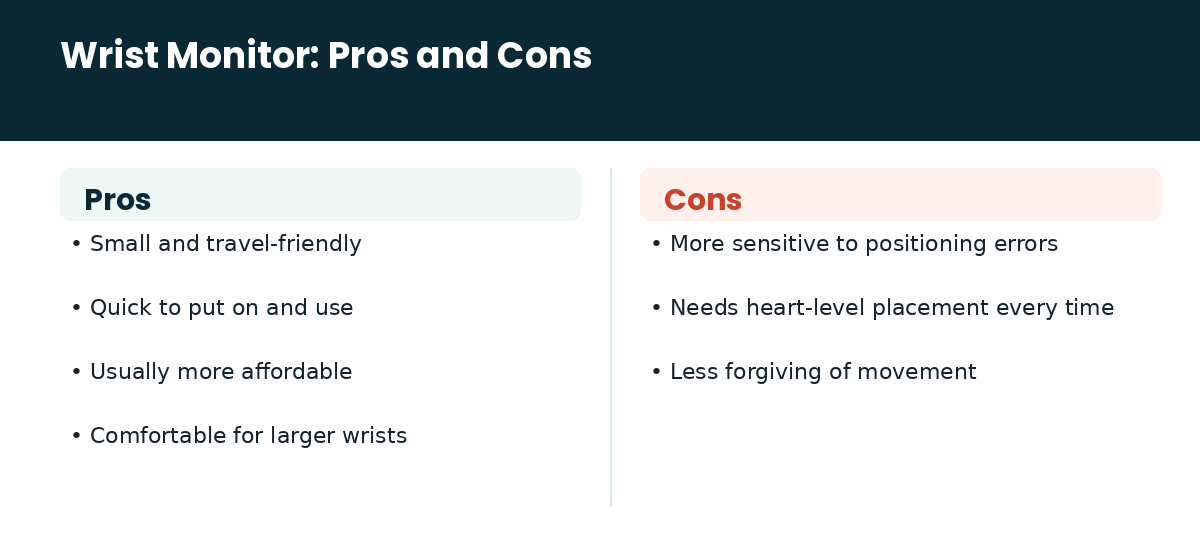
The biggest advantages of a wrist monitor are its size and speed. It is small enough to keep in a bag, a drawer, or even a coat pocket, and it takes seconds to wrap around your wrist and start a reading. It also tends to be more comfortable for people with larger wrists, and is usually more affordable than an equivalent arm monitor.
The trade-off is precision around technique. Because the wrist artery is narrower and closer to the skin’s surface than the artery in your upper arm, a wrist monitor is more sensitive to positioning errors (Mayo Clinic on wrist monitor accuracy). Every reading needs your wrist held at heart level, and movement during the measurement can throw off the result more noticeably than it would with an arm monitor.
Arm Monitor: Pros and Cons
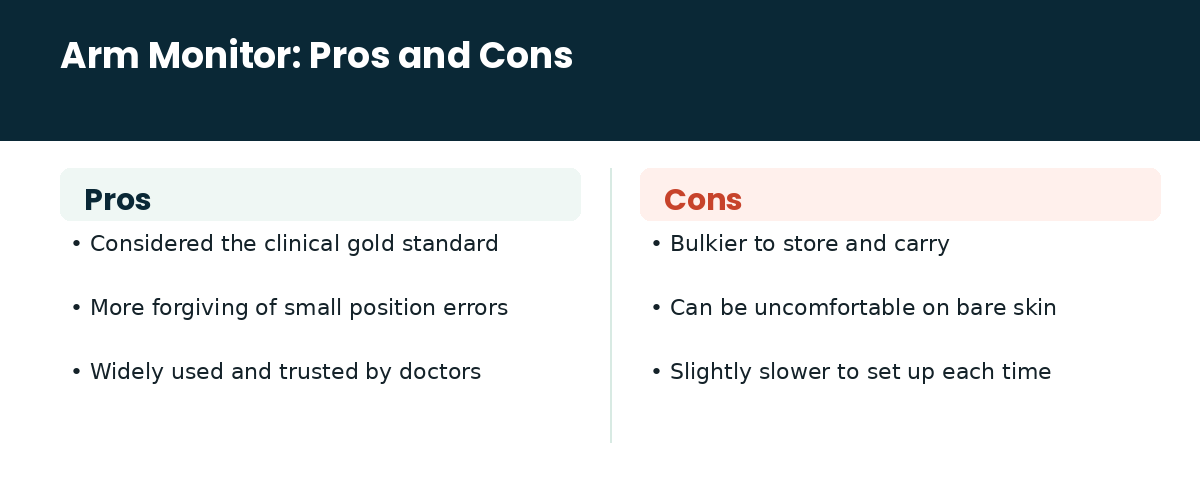
Arm monitors are widely regarded as the clinical gold standard, and are what most doctors will recommend by default, particularly for patients with existing heart conditions who need dependable, consistent tracking over time (American Heart Association on home monitoring). They are also somewhat more forgiving of minor position mistakes, since the upper arm artery sits deeper and is less affected by small shifts in placement.
The downside is practicality. Arm monitors are bulkier to store and carry, some people find the cuff uncomfortable on bare skin, especially with repeated daily use, and the whole process of wrapping the cuff correctly around the upper arm takes a little longer than simply strapping on a wrist unit.
Who Should Use Each
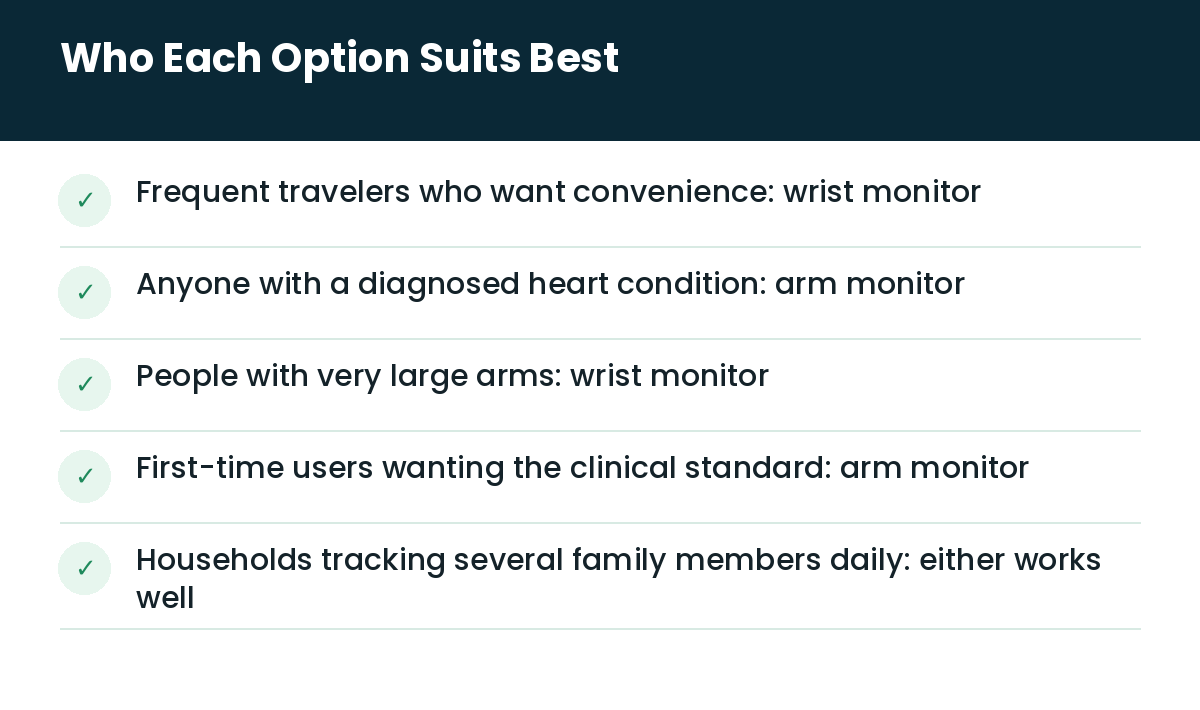
Putting the pros and cons together, some clear patterns emerge. Frequent travelers who want convenience above all else tend to do best with a wrist monitor. Anyone with a diagnosed heart condition, or who is monitoring under specific medical instruction, is generally better served by an arm monitor. People with very large arms who struggle to find a properly fitting arm cuff often find a wrist monitor more practical. First-time users who want the most clinically consistent option, without needing to think too hard about positioning technique, may prefer starting with an arm monitor. And households tracking blood pressure for several family members, say, an elderly parent and a working adult, often find that either option works well, as long as everyone uses their device correctly and consistently.
A Note on Accuracy for Both Types
It is worth repeating that neither type is inherently more or less trustworthy than the other; each simply has a different margin for error. An arm monitor used carelessly, with the cuff placed over clothing or positioned incorrectly, can be just as inaccurate as a poorly used wrist monitor. The technology inside both device types is fundamentally similar, an inflatable cuff and a digital pressure sensor. What changes is how forgiving each one is of small mistakes in technique.
The Centers for Disease Control and Prevention notes that correct cuff size and proper use matter enormously for accuracy, regardless of which type of device you are using (CDC on blood pressure accuracy). This is really the underlying lesson across both device types: technique matters more than the device category itself.
Making Your Final Decision
If you have read through both the pros and cons above and are still torn, ask yourself which scenario applies to you most: do you want maximum convenience for daily use, or maximum forgiveness of technique errors for clinical-level tracking? There is no wrong answer, only the one that matches your actual lifestyle and health needs.
Shop ClinicAid’s Wrist Monitors
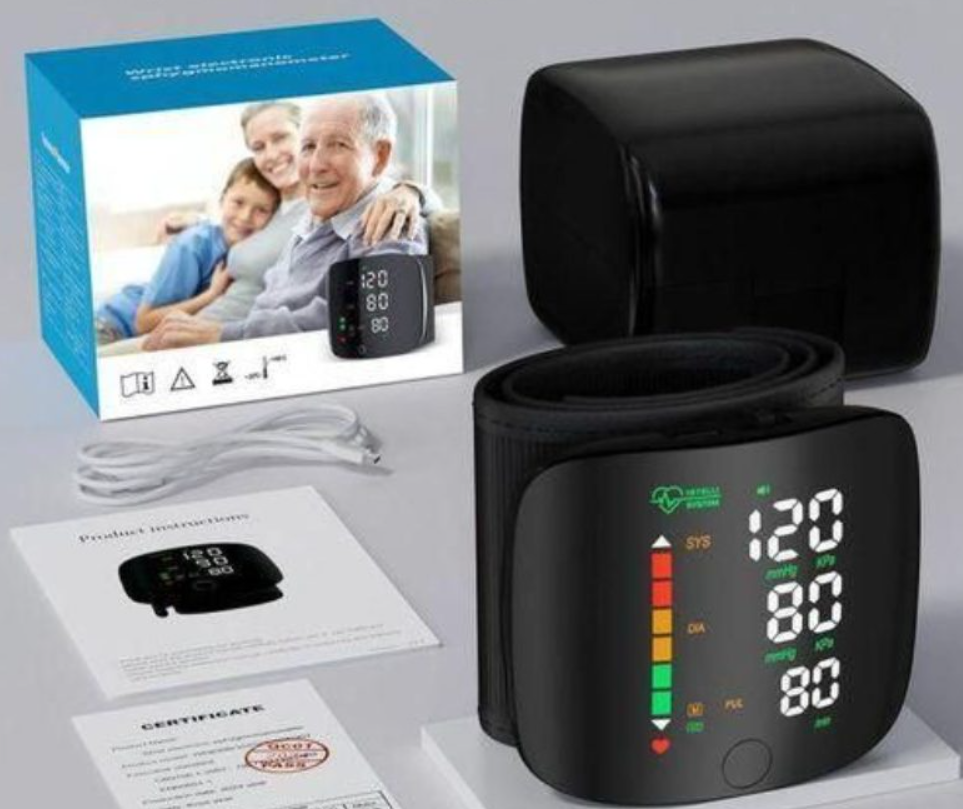
If you have decided a wrist monitor fits your needs, ClinicAid offers a few options depending on your priorities. Our Digital Wrist Blood Pressure Monitor is our best all-rounder for home use, our Portable Digital Wrist Blood Pressure Monitor is built specifically for people on the move, and our standard Wrist BP Monitor offers reliable everyday tracking at a lower price point.
Final Thoughts
Both wrist and arm monitors have real, specific advantages, and real, specific limitations. Understanding exactly what you are trading off, convenience for forgiveness of error, or bulk for clinical consistency, is what allows you to choose the device you will actually use correctly and consistently, which matters far more than the category of device itself.
For more detailed comparisons like this one, visit the ClinicAid blog.
A Balanced Way to Think About This Decision
It is easy to read a pros and cons list and feel like you need to pick the “winning” option, but that is not really how this decision works. Both device types are used successfully by millions of people worldwide every day. The right choice is simply the one whose specific downsides you can most easily manage in your own daily routine. If remembering to hold your wrist at heart level is easy for you, the wrist monitor’s main limitation barely matters. If carrying a bulkier device around does not bother you, the arm monitor’s main limitation barely matters either. Choose based on what you can realistically live with, not based on which list of pros looks longer on paper.
Frequently Asked Questions
Which type is better for elderly users specifically? This depends more on dexterity than age alone. Many elderly users find a wrist monitor easier to put on independently, since it requires less strength and coordination than wrapping and securing a larger arm cuff. However, if a caregiver is present to help, an arm monitor’s slightly higher forgiveness of positioning error can be an advantage.
Is one type more comfortable for daily long-term use? Most users report that wrist monitors feel less intrusive for daily use, since the cuff is smaller and the whole process is quicker. Comfort is somewhat subjective, though, and some people simply prefer the familiar feel of an arm cuff.
Do pros and cons change for people with irregular heartbeats? Some digital monitors, wrist or arm, may have difficulty producing a reliable reading for people with certain heart rhythm irregularities. If you have a diagnosed arrhythmia, it is worth discussing the most suitable device type with your doctor, since accuracy considerations can differ from the general population.
Can pregnant women use either type safely? Both wrist and arm monitors are generally safe for home use during pregnancy, but blood pressure monitoring during pregnancy often has specific clinical importance, so it is best to follow your doctor or midwife’s specific recommendations on device type and monitoring frequency.
Which option is easier to travel with internationally? Wrist monitors have a clear advantage here, given their compact size and lighter weight. If you travel internationally and want to keep monitoring consistently, a wrist monitor is generally the more practical travel companion.
Does the pros and cons list change for someone monitoring blood pressure after starting new medication? Not fundamentally, but consistency becomes even more important during this period, since your doctor will want to see how your numbers respond to the medication over time. Whichever device type you choose, using it at the same times daily gives your doctor a clearer picture than switching between devices or measuring irregularly.

Digi Clinicaid Nigeria Ltd is an online medical marketplace in Nigeria.