High blood pressure is one of the most common health conditions in Nigeria today, and one of the quietest. It rarely announces itself with pain or discomfort, which is exactly why so many people only discover they have it after a stroke, a kidney problem, or a heart complication has already happened.
The World Health Organization estimates that an enormous share of adults living with hypertension worldwide do not even know they have it (WHO hypertension fact sheet), and that is exactly the gap that home monitoring is meant to close.
If you have started looking into home blood pressure monitors, you have probably noticed that blood pressure monitors for wrist keep coming up as one of the most convenient options. This guide walks you through what a wrist blood pressure monitor actually is, who it is best suited for, and what to check before you buy one in Nigeria.
What Are Blood Pressure Monitors for Wrist?
A wrist blood pressure monitor is a small, self-contained device that wraps around your wrist instead of your upper arm. It uses the same basic technology as most digital arm monitors, an inflatable cuff that measures the pressure of blood moving through the radial artery in your wrist, then displays your systolic pressure, diastolic pressure, and pulse rate on a digital screen.
Because it is compact and does not require a separate pump or tubing, a wrist monitor is often the easiest option for people who want something quick, portable, and simple to operate without help.
Why Nigerians Are Turning to Home Monitoring
Clinic visits are not always convenient. Traffic, distance, cost, and time off work all add friction to something as simple as checking your blood pressure. A home monitor removes almost all of that friction. You check your numbers in your own living room, in under a minute, whenever you want.
This matters even more for households caring for older relatives. If you have a parent managing hypertension, a wrist monitor lets them track their own numbers daily and share the readings with you or their doctor, rather than waiting for the next hospital appointment to find out how they are doing.
The American Heart Association specifically recommends home monitoring for anyone already diagnosed with high blood pressure, since it helps confirm whether treatment is actually working between visits (AHA home blood pressure monitoring guidance).
What to Look For Before You Buy
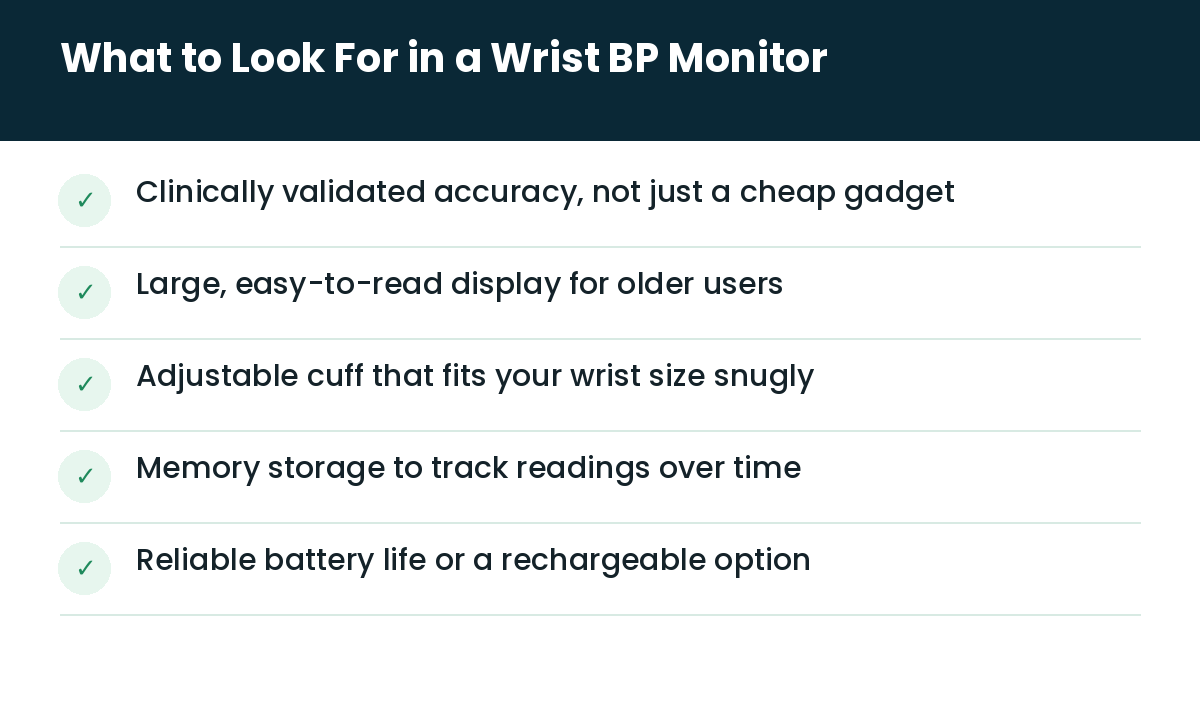
Not every wrist monitor on the market is built the same way. Here is what actually matters when you are comparing options:
Validated accuracy. Look for a monitor that has been clinically validated rather than an unbranded device with no testing behind it. Accuracy is the entire point of owning one.
A clear, large display. Many buyers are shopping for an older parent, so a screen with big, high-contrast numbers matters more than it might seem.
Proper cuff fit. Your wrist size affects your reading. A cuff that is too loose or too tight will distort the numbers, so check that the monitor has an adjustable cuff sized for adult wrists.
Memory function. A monitor that stores previous readings lets you or your doctor spot patterns over time, rather than reacting to a single number in isolation.
Battery life or rechargeability. Some monitors run on standard batteries, others are rechargeable. Either works, but you should know which one you are buying and plan accordingly.
If you want a monitor that checks all of these boxes, our Digital Wrist Blood Pressure Monitor was built with exactly this list in mind, one-touch automatic readings, a large display, and a memory function for tracking trends over time.
Wrist Monitors vs Arm Monitors
This is usually the first real decision buyers face, so it is worth understanding the trade-offs clearly.
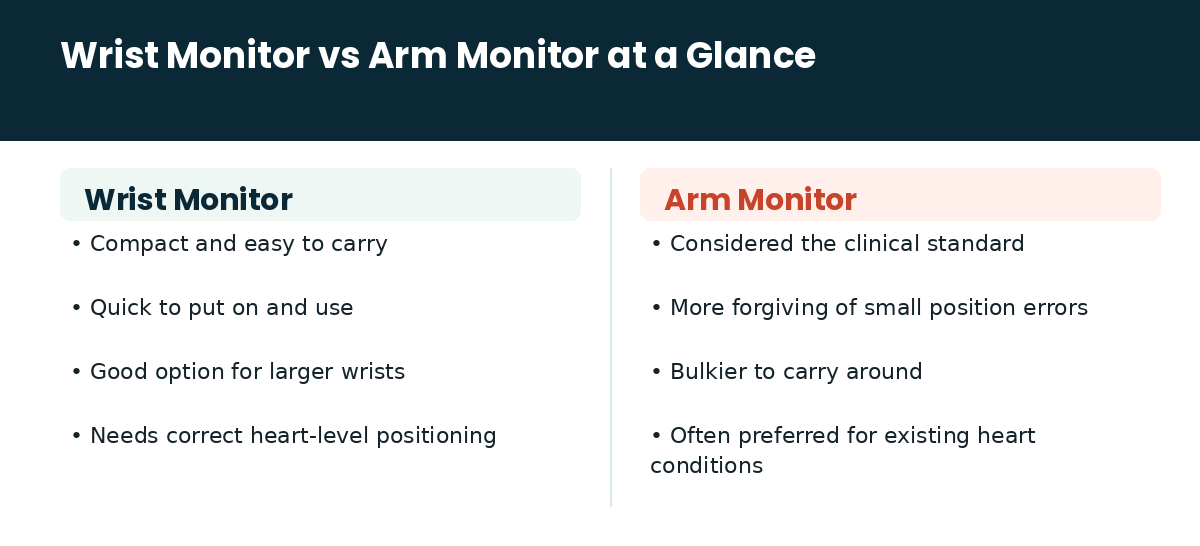
Clinical guidelines still tend to favor upper arm monitors as the reference standard, largely because they are less sensitive to positioning errors (Mayo Clinic on wrist monitor accuracy). That said, a wrist monitor used correctly, meaning positioned at heart level and used consistently, can still give you a genuinely useful picture of your blood pressure at home, especially for daily tracking rather than a single diagnostic reading.
For many Nigerian households, particularly people who travel often, people with larger arms that do not fit standard arm cuffs well, or anyone who simply wants the simplest possible option, a wrist monitor is a practical, affordable middle ground.
Understanding Your Numbers
Once you start measuring at home, it helps to actually understand what your numbers mean. Here is a quick reference based on standard medical guidelines.
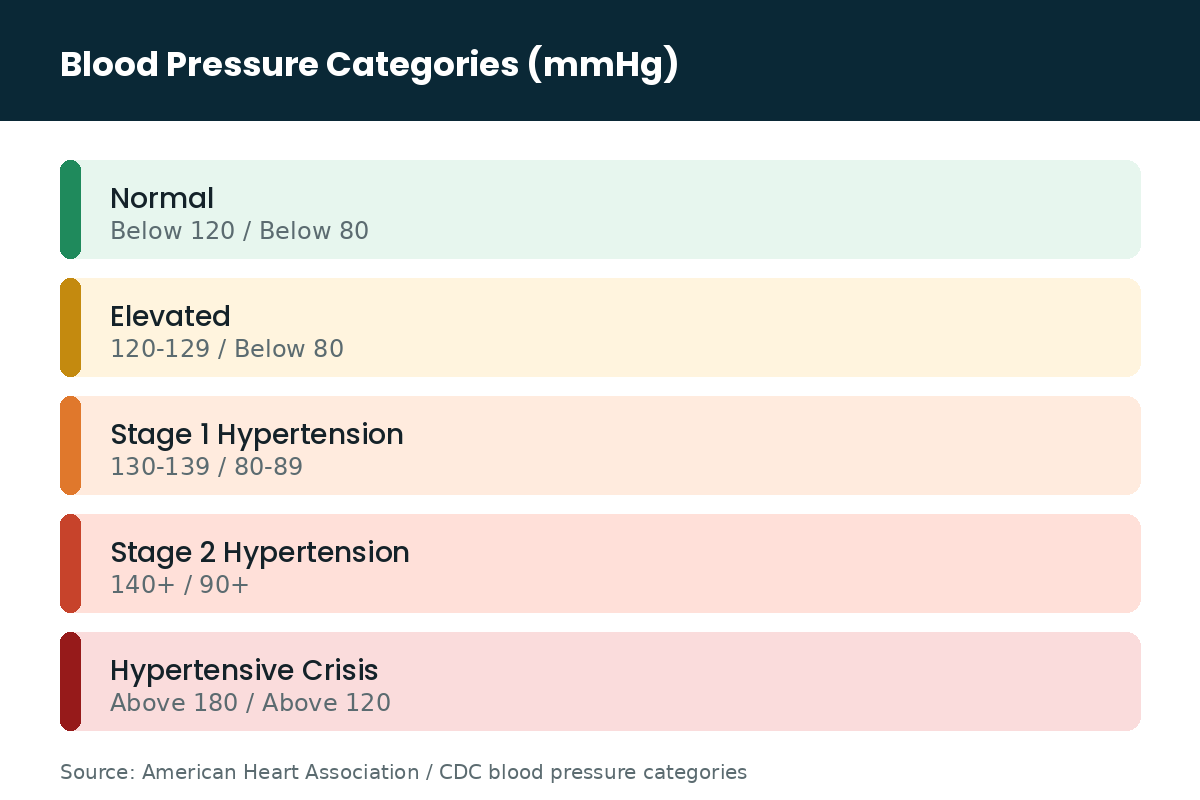
A reading below 120/80 mmHg is generally considered normal. Numbers climbing above that, especially consistently above 130/80 mmHg, are worth discussing with a healthcare professional, and anything above 180/120 mmHg is a medical emergency that needs immediate attention, not a home remedy (CDC on high blood pressure categories).
Buying Your First Wrist Monitor in Nigeria
If you are ready to start monitoring at home, ClinicAid stocks two well-reviewed options depending on what you are looking for:
- The Digital Wrist Blood Pressure Monitor, our most popular option for home use, with one-touch readings and a large display.
- The Wrist BP Monitor, a compact alternative built for everyday convenience.
- If portability is your main priority, our Portable Digital Wrist Blood Pressure Monitor is designed to travel easily in a bag or car.
All three ship nationwide, and our team reaches out shortly after you order to confirm delivery.
Final Thoughts
A wrist blood pressure monitor will not replace your doctor, but it gives you something most people in Nigeria have never had easy access to: a daily, private window into your own heart health. Used correctly, it can catch a problem early enough to actually do something about it, which is exactly the point.
For more guidance on getting the most accurate readings and understanding what your numbers mean, browse our other health articles on the ClinicAid blog.
Frequently Asked Questions
Is a wrist blood pressure monitor good enough for daily use? Yes, for most people a wrist monitor is perfectly suitable for daily tracking, as long as you use correct technique each time, keeping your wrist at heart level and staying still during the reading. It becomes less reliable for people who cannot maintain consistent positioning, such as someone with limited mobility in that arm.
How much does a wrist blood pressure monitor cost in Nigeria? Prices vary depending on the brand and features, but a validated digital wrist monitor from ClinicAid typically costs around twenty thousand naira, which is generally more affordable than an equivalent arm monitor with similar features.
Can I use a wrist monitor if I already own an arm monitor? Yes, some households actually keep both, using the arm monitor for periodic, more clinically rigorous checks and the wrist monitor for quick daily tracking. There is no harm in having both, as long as you understand that a wrist reading requires careful positioning to be trusted.
Do I need a doctor’s prescription to buy one? No, blood pressure monitors, including wrist models, are available over the counter and can be ordered directly online in Nigeria without a prescription. That said, if you are newly diagnosed with hypertension, it is worth discussing your monitoring routine with your doctor.
How do I know if my wrist size will fit the cuff? Most digital wrist monitors, including ours, use an adjustable cuff designed to fit the wrist sizes of the vast majority of adults. If you have concerns about an unusually small or large wrist, our team can advise you before you order, just reach out through WhatsApp or the contact details on our site.

Digi Clinicaid Nigeria Ltd is an online medical marketplace in Nigeria.